
Founder guide
How to start a soap brand
The rule that decides everything about a soap business: whether your product is true soap regulated as a consumer product, a cosmetic under FDA rules including MoCRA, or a drug. Plus saponification, cure time, labeling, and cost structure.
Direct answer
Soap sits in one of three regulatory categories and your marketing decides which. True soap, made of alkali salts of fatty acids, cleansing because of those, and sold only as soap, is a consumer product under CPSC. Add a moisturising or deodorant claim, or use a synthetic detergent base, and it becomes a cosmetic subject to FDA rules including MoCRA facility registration and product listing. Add an antibacterial or therapeutic claim and it becomes a drug.
Which of the three categories your soap is in
This is the single most consequential decision in the category and most founders make it accidentally, through a sentence on a product page. The regulatory definition of soap is narrow: the bulk of the non-volatile matter consists of alkali salts of fatty acids, the detergent properties come from those compounds, and the product is labeled, sold, and represented only as soap. A product meeting all three is a consumer product regulated by the CPSC rather than a cosmetic.
Break any one of the three and the product becomes a cosmetic. A syndet bar built on synthetic surfactants is a cosmetic even if it looks identical. So is a true soap sold on the promise that it moisturises, softens, or deodorises, because those are cosmetic claims and the third condition fails. That reclassification is not merely semantic: cosmetics carry ingredient labeling requirements and, under the Modernization of Cosmetics Regulation Act, facility registration and product listing obligations along with safety substantiation and adverse event reporting.
Go further and claim the product treats acne, kills germs, or relieves eczema, and it becomes a drug, which brings a pre-approval regime a small brand cannot realistically satisfy. The practical discipline is to write the product copy after deciding the category, and to treat every adjective on the label and the website as a regulatory choice.
Marketing decides classification. A bar you intended as simple soap becomes a cosmetic the moment your product page promises what it does for skin.
Making it: saponification, superfat, and cure
Cold process soap is made by reacting fats and oils with an alkali, sodium hydroxide for bars and potassium hydroxide for liquid soap. The reaction is saponification and it is exothermic and genuinely hazardous during handling: lye burns, and the safety equipment and ventilation are not optional. Hot process accelerates the reaction with heat; melt and pour uses a pre-made base and skips the lye handling entirely, which is why it is the common starting point.
Superfat is the deliberate excess of oil left unsaponified, and it is a formulation choice that trades lather and hardness against conditioning feel. Each oil contributes a different profile, which is why soap formulation is expressed as an oil blend by percentage rather than a recipe, and why a substitution changes the product materially.
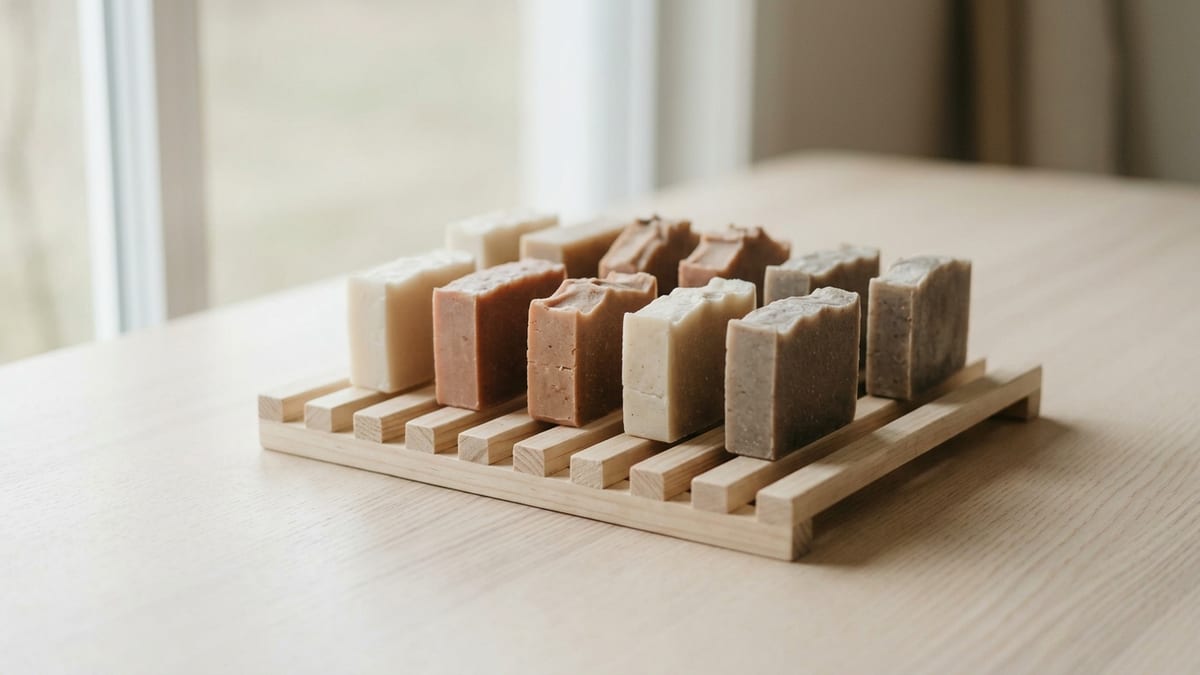
Cure time is the constraint that shapes the whole operating plan. Cold process bars need weeks of curing for water to evaporate and the bar to harden, which means production has to run well ahead of demand and your first launch calendar has to include a period where you are making inventory and selling nothing. Founders consistently underestimate this and end up launching with bars that are too soft, dissolve quickly, and generate complaints that read as quality problems.
- Express the formulation as an oil blend by percentage, plus lye and water quantities
- Record the superfat percentage, because it defines the bar’s character
- Plan cure time into the launch calendar as dead weeks of production
- Melt and pour removes lye handling and also removes formulation control
Labeling depends on which category you chose
For true soap regulated as a consumer product, the Fair Packaging and Labeling Act requirements apply: an identity statement, the net quantity of contents, and the name and place of business of the responsible party. A full ingredient declaration is not required in the way it is for cosmetics, though many brands include one voluntarily because customers expect it.
For a cosmetic, the requirements expand. Ingredients are declared in descending order of predominance using established nomenclature, with colour additives and permitted trade secret handling following specific rules. Warning statements apply where relevant. MoCRA adds obligations at the company level rather than the package level, including facility registration and product listing, with small business exemptions that have conditions worth reading rather than assuming apply to you.
Fragrance and essential oils bring their own layer. Suppliers should provide safety data sheets and usage guidance, and the International Fragrance Association publishes usage standards by product type. Leave-on and rinse-off products have different limits, so a fragrance safe in a soap is not automatically safe in a lotion, which matters the moment the line extends beyond bars.
Cost, weight, and the shipping problem
Soap has attractive input economics and unattractive shipping economics. Oils, lye, fragrance, and colour are inexpensive per bar relative to most personal care, and a well run small operation can hold a healthy gross margin. Then a single bar goes into a parcel and the shipping cost approaches or exceeds the product price.
The structural answers are the same ones the category has always used: sell multi-bar sets, build bundles that carry freight better, price shipping into the product rather than presenting it separately at checkout, and treat wholesale to shops as a serious channel rather than an afterthought, because a case going to one address solves the problem outright.
Cure time also has a cash flow consequence that belongs in the plan. Inventory made weeks before it can be sold is working capital sitting on a rack, and a launch that sells out is followed by a gap you cannot compress by working harder.
- Bars are dense, so actual weight rather than dimensional weight drives the parcel cost
- Multi-bar sets and wholesale cases are the two structural fixes for freight
- Cure time turns inventory into working capital held for weeks
- Bar weight settles during cure, so net weight is declared after curing, not before
Getting to a sellable soap brand with Dough
Dough starts while the line is still a description. You say what the bars are, the scent and material direction, and who buys them, and it returns several drafts, each with a product design, a packaging concept, and a brand. Drafts are refined in plain language and nothing commits until you pick one. They come in two shapes: a catalog product a manufacturer in the network already makes, which is faster and cheaper, and a custom product that needs real development work.
Building the draft publishes a storefront on its own address. You set the price and Dough shows the unit cost and what each sale leaves you before you commit, so the price and the cost are not maintained separately. Because this category has a cure time between making and selling, the storefront collecting waitlist signups or pre-orders while inventory cures is a practical fit rather than a theoretical benefit. Pre-order funds are held in escrow and refunded if the launch threshold is not met. Sampling, production with vetted manufacturers, and fulfillment follow in the same account, with ads and analytics alongside.
Design and brand lock when the product is built, so refinement happens on drafts rather than after. You own the business fully and Dough takes no equity. Pricing is one plan at $29 per month plus a share of what you sell, with no setup fee. Because Dough runs a public MCP server, the same workflow can be driven from a chat client.
What stays with you: the classification decision, cosmetic safety substantiation where it applies, MoCRA obligations, and the wording of every claim.
What changes about the order
- Having something to show
- UsuallyPackaging and a batch are made first, then cured for weeks, before anyone outside has seen the line.
- With DoughThe concept, the packaging, and the storefront exist as soon as the line is described.
- Setting the price
- UsuallyA price benchmarked against a market stall, then reconciled against parcel shipping after launch.
- With DoughThe price is set against a visible unit cost, so the margin is known before a batch is poured.
- Using the cure weeks
- UsuallyInventory sits curing while nothing is being sold and no demand is being gathered.
- With DoughPre-orders against a launch goal accumulate during the cure, so the batch answers real demand.